

Government Body Chooses ITSM for Processes, Activate for Workforce Lifecycle Automation
Customer Snapshot
Industry: New Zealand public sector
Environment: HR systems, ServiceNow and connected identity and business systems
Operational challenge: Elections, cabinet reshuffles and other events that create significant volumes of workforce changes
Jobs to be done: Automate onboarding, role changes and offboarding while reducing service desk workload and maintaining accurate access
Solution: Activate Identity Lifecycle
The Challenge
This customer supports an environment where workforce requirements can change quickly. Elections and cabinet reshuffles create a sharp increase in new starters, departures and people moving between roles.
Each workforce change brings identity work with it. Accounts need to be created. Access must be assigned or updated. Permissions that are no longer appropriate need to be removed. Eventually, departing users must be offboarded accurately and on time.
Many of these processes relied on forms, service desk tickets and manual activity across different teams. The existing ITSM platform provided workflow visibility, but the provisioning work behind those workflows still required significant manual effort.
During normal periods, this created a steady administrative workload. During a major political event, the same processes could quickly become unsustainable.
The Jobs They Needed to Get Done
Our customer needed a more reliable way to:
Onboard large numbers of people during peak periods
Update access when people changed roles
Remove access accurately when people left
Reduce repetitive identity tickets
Avoid adding temporary IT staff to handle election demand
Apply provisioning processes consistently
Reduce the risk of mistakes during complex access changes
Keep identity activity visible and auditable
Lower the cost of delivering and licensing identity services
The goal was not simply to move forms from one platform to another, they needed to automate the identity work happening behind each workforce change.
Where the Hidden Costs Were Building
The cost of manual identity operations was spread across a large number of relatively small tasks.
Each new starter could generate several tickets. A role change could require updates across multiple systems and resolver groups. An offboarding request could involve a series of manual actions, each with its own hand-off and opportunity for delay.
These tasks did not always appear as one large problem. The cost showed up as growing ticket volumes, service desk pressure, manual errors and IT staff pulled away from other work.
Peak events made that operational drag much easier to see. During an election, normal workforce processes had to handle a much larger volume of changes within a short period. Without deeper automation, Parliamentary Service would have needed more IT capacity simply to keep up.
There were also costs beyond the service desk. Inconsistent provisioning could affect employee productivity, while delayed or incomplete access removal increased security and compliance risk. Licensing costs added another layer of expense.
The Solution: Automate the Work Behind Each Workforce Change
Our customer chose Activate’s Identity Lifecycle solultion to automate workforce identity management and provisioning.
Activate integrated with the organisation’s HR systems, ServiceNow and existing workflows. This allowed identity activity to move from request-led manual processing to more consistent, automated execution.
The solution supported:
New-user onboarding
Role and access changes
Employee offboarding
Automated identity provisioning
Consistent execution of repeatable workflows
Integration with existing HR and ITSM processes
Tracking and auditability of identity changes
Instead of relying on IT teams to complete every provisioning step manually, Activate carried out eligible identity work automatically across the connected environment.
This reduced the number of separate tickets and manual actions required for each workforce event. It also helped limit errors during complex provisioning tasks and gave Parliamentary Service a more scalable way to prepare for predictable periods of high demand.
Giving Each Platform a Clear Job
ServiceNow remained part of our customer’s operational environment. Activate provided the deeper identity automation needed to execute workforce lifecycle changes.
This gave each platform a clearer job:
HR systems provided workforce information
ServiceNow supported service management processes
Activate automated identity provisioning and lifecycle execution
Connected systems received the required account and access changes
The result was a joined-up process without requiring one platform to perform every part of the job.
“Activate’s joined-up solution and broad modular capability have significantly reduced our IT workload and improved accuracy, especially during high-demand periods like elections”
Key Outcomes
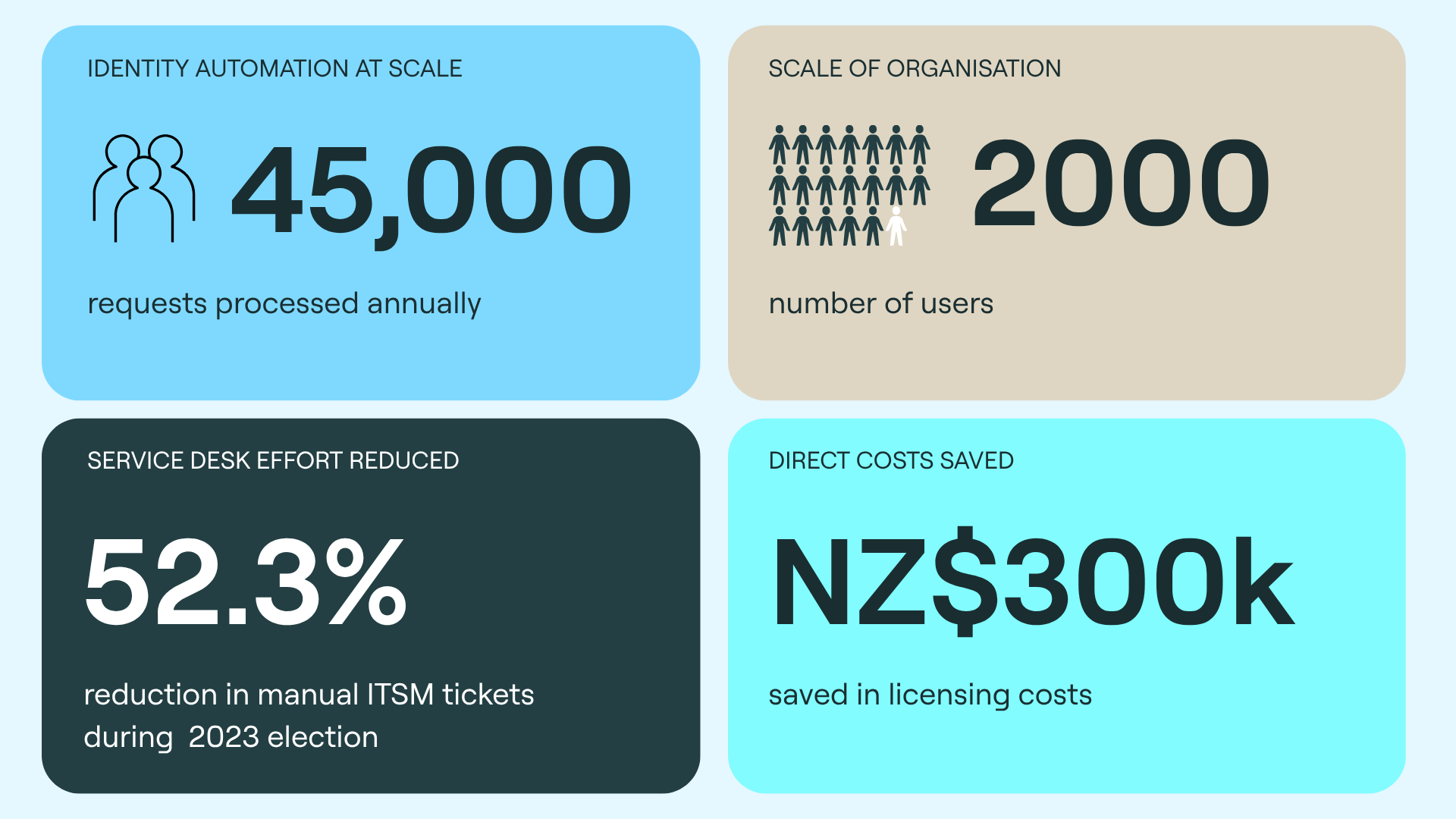
Manual ITSM tickets reduced by approximately 52.3% during Election 2023
More than 45,000 requests processed annually
Approximately NZ$300,000 saved in licensing costs
No additional IT staff required during the election peak
Less repetitive provisioning work for IT and service desk teams
More consistent identity lifecycle execution
Fewer opportunities for manual errors
Improved accuracy across workforce identity changes
A more scalable model for elections and cabinet reshuffles
Better use of existing HR, ITSM and identity systems
The Bottom Line
The hidden cost of workforce identity management did not come from one large task. It came from the number of small tasks triggered every time someone joined, moved or left.
During an election, those tasks multiplied quickly. More forms. More tickets. More hand-offs. More provisioning work for teams already under pressure.
By automating the identity work behind those changes, Parliamentary Service reduced manual tickets by 52.3% and handled the election period without adding more IT staff.
The result was not simply fewer tickets. It was a workforce lifecycle process able to absorb a major operational peak without the service desk workload growing alongside it.
Could Your Identity Processes Handle a Sudden Workforce Peak?
If onboarding, role changes and offboarding still depend on forms, tickets and manual fulfilment, we can help you identify where automation could remove the greatest operational burden.