

Why a National Retailer Moved Their Complex Identity Work Back to Activate After Confronting the Hidden Costs of ITSM Delivery.
Customer Snapshot
Organisation: Large national retailer
Industry: Retail
Environment: PayGlobal, Jira Service Management, Active Directory, Microsoft 365 and other critical systems.
Users supported:11,700
Jobs to be done: Automate identity lifecycle processes, access provisioning and complex service requests while improving service delivery and reducing platform costs
Solution: Activate Identity Operations
The Challenge
This national retailer was struggling to implement automated user lifecycle management and computer asset management through its incumbent ITSM provider.
High development costs, offshore support issues and unexpected maintenance expenses were creating inefficiencies and affecting the user experience. They needed a more practical way to automate their identity lifecycle processes and complex service requests without adding further cost and complexity.
The Jobs-to-Be-Done Decision
The decision was not simply about choosing one platform over another, it was about identifying the job each platform needed to do.
Jira Service Management: Manage incidents and changes.
Activate: Automate identity lifecycle processes, access provisioning and complex service requests.
The integration between them: Keep service management and identity execution connected.
This meant our customer could modernise their service management environment without giving up the identity automation already connected to their critical systems.
Why Their Complex Identity Work Stayed in Activate
As the programme progressed, our customer found that some jobs were better suited to a specialist identity automation platform. They had struggled to implement automated user lifecycle management and computer asset management through its incumbent ITSM provider. These were not simply request forms. They involved rules, integrations and actions across PayGlobal, Active Directory, Microsoft 365 and other critical systems.
Activate was already connected to this environment and built to carry out the work behind each request. It could automate identity lifecycle processes, access provisioning and more complex service requests without requiring our customer to recreate established automation inside their ITSM platform.
This allowed the organisation to make fuller use of Activate for the identity work it was designed to perform, while Jira Service Management focused on incident and change management.
How Hidden Costs Shaped Their Decision
The cost of moving complex identity work into an ITSM platform was not limited to software licensing. They also faced high development costs, offshore support issues and unexpected maintenance expenses. These costs created inefficiencies and affected the user experience.
Every workflow that had to be rebuilt, maintained or supported added another layer of cost. Complex identity processes also depended on integrations with HR, directory and business systems, making them more difficult to reproduce than a standard service request.
Keeping this work in Activate reduced the need to rebuild proven automation elsewhere. It also gave our customer a clearer operating model: Jira Service Management could manage incidents and changes, while Activate executed identity and lifecycle work across connected systems.
The Outcome: A Connected Model for Different Jobs
Our customer integrated Activate with Jira Service Management and divided the work according to each platform’s strengths. JSM was used for incident and change management. Activate was used for identity management, employee lifecycle processes, automated provisioning and complex service requests.
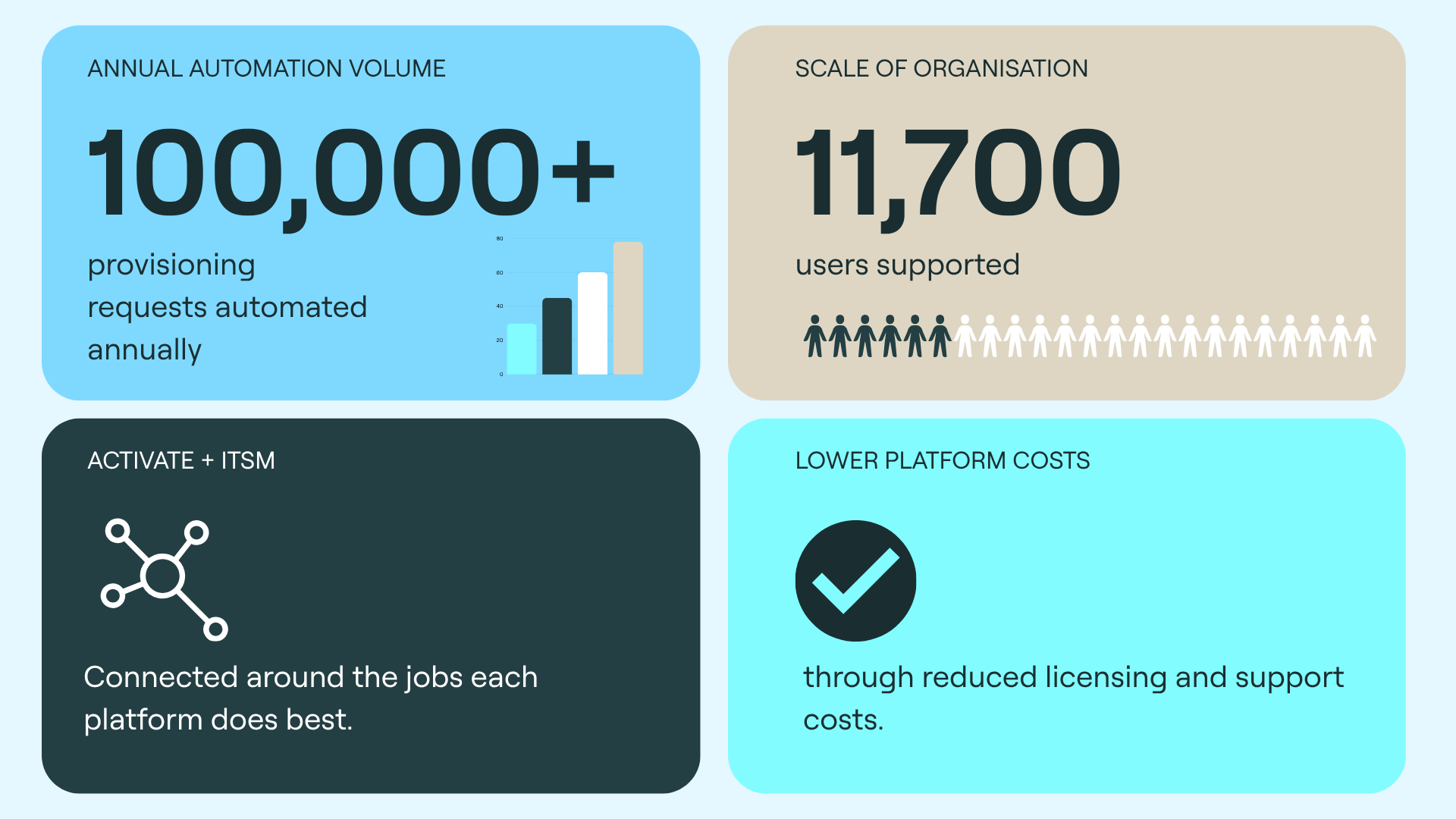
Today, Activate processes more than 100,000 provisioning requests annually across 11,700 users. The model has improved service delivery and automation while reducing licensing and support costs. It also provides a stronger foundation for future security, audit and governance improvements, including opportunities to avoid unnecessary cloud licence costs.
“Activate’s tight integration with our systems and its robust automation capabilities have streamlined processes and significantly reduced costs.”
Key Outcomes
More than 100,000 provisioning requests processed annually
Identity services delivered across 11,700 users
Improved service delivery and automation
Reduced licensing and support costs
Stronger integration with Active Directory and Microsoft 365
A foundation for future security, audit and governance improvements
Opportunities to avoid unnecessary cloud licence costs
The Bottom Line
ITSM and identity automation solve related—but different—problems.
An ITSM platform can provide the place where people raise requests and teams manage operational work. Activate handles the specialist identity work that happens after a request is approved: provisioning accounts, changing access, updating connected systems and removing access when it is no longer needed.
For this retailer, separating those jobs created a simpler and more sustainable model. It preserved valuable automation, avoided unnecessary redevelopment and kept high-volume identity processes moving.
Planning a change to your ITSM environment?
See how Activate can preserve and extend identity automation while your ITSM platform manages incidents and changes.