
Coexistence
Keep ServiceNow. Get more value from it.
ITSM platforms like ServiceNow are excellent at managing work across IT. But identity work often needs to move beyond the ticket into approvals, provisioning, fulfilment and lifecycle changes across multiple systems. Activate works alongside ServiceNow and other ITSM platforms to automate that execution.
ServiceNow remains the place people request and track work. Activate handles the identity processes behind it, accurately and at scale.
Trusted at scale
300k+
Automated enterprise tasks
107k+
Automated retail requests each year
52%
Reduction in required ServiceNow tickets
Is this for you?
It may be a good fit when:
✔ Identity requests involve multiple systems or teams
✔ Onboarding, role changes or offboarding still create tickets
✔ Approvals and fulfilment depend on manual follow-up
✔ ServiceNow is the front door, but execution happens elsewhere
✔ Identity volumes or complexity are becoming difficult to manage
Activate Identity Automation Platform is designed for organisations that want to keep ServiceNow while automating more of the identity work behind it.
Want to explore how a similar coexistence model could work in your environment? Read our guide for architects planning ServiceNow identity automation before go-live, or talk through your ServiceNow environment with our experts.
Works with the systems you already use.
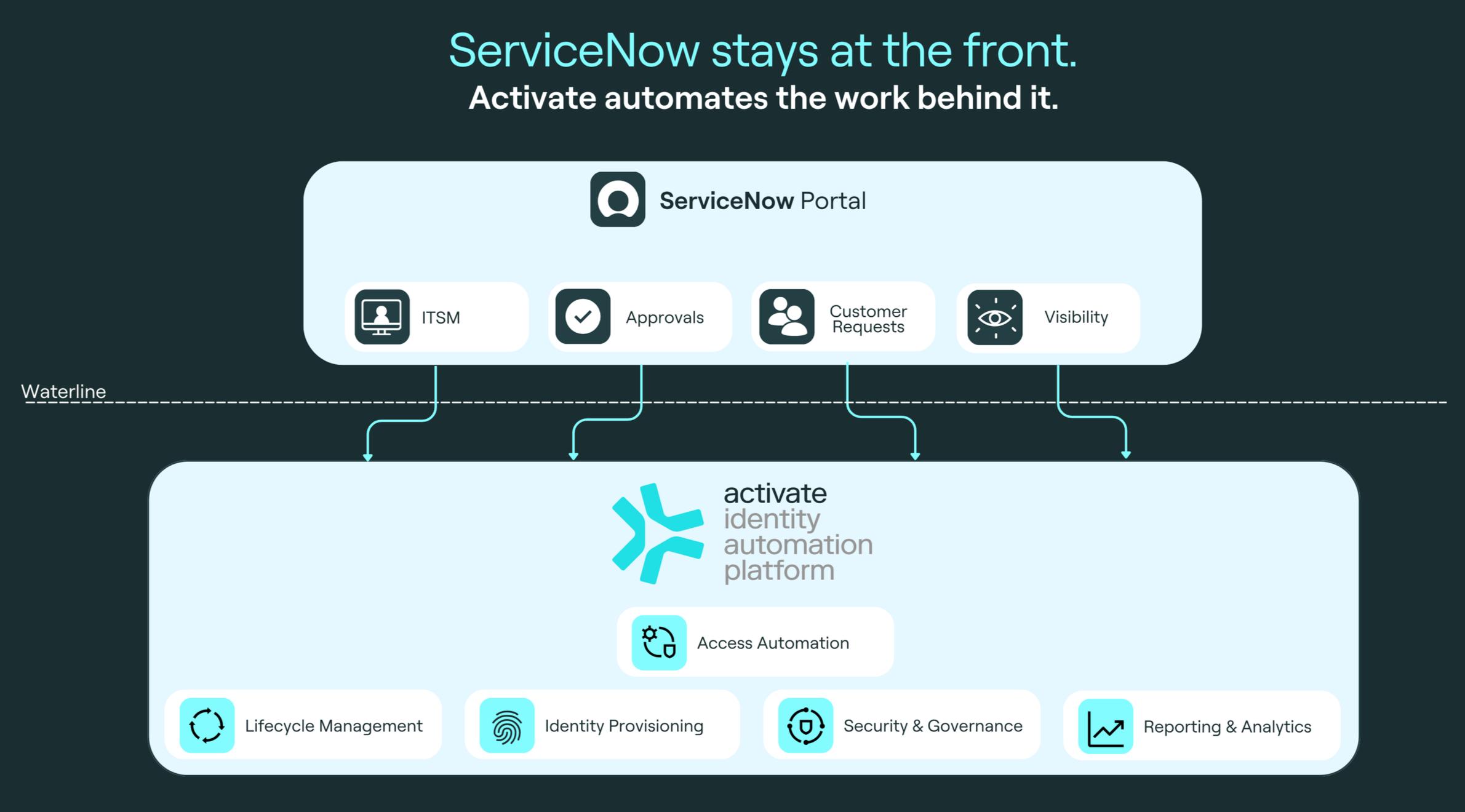
Activate connects ServiceNow with the identity, HR and business systems involved in each process.
Requests can begin in ServiceNow. Activate coordinates approvals, provisioning and fulfilment across connected platforms, then returns status and outcomes to the service workflow.
ServiceNow manages the work. Activate executes the identity process.

ServiceNow stays at the centre of service management, while Activate works behind it to automate onboarding, offboarding, role changes, access requests, approvals and fulfilment across connected systems.
When a process can be automated, Activate executes it. When human action is still needed, the work remains visible in ServiceNow.
You keep the platform your teams already use while reducing the manual identity work moving through it.
Proven in enterprise environments.
Enterprise IT teams can build identity workflows inside their ITSM, but complex identity processes can introduce custom development and ongoing maintenance as requirements expand across systems.
Activate provides another model: keep ServiceNow focused on service management while Activate handles identity automation across the connected environment.
Government Lifecycle Automation.
See how a government body cut their required ServiceNow tickets by over 52% by automating workforce lifecycles.
Read the case study here.
Retail Identity Automation.
See how a national retailer uses Activate to handle over 107,000 automated provisioning requests annually.
Read the case study here.
Global Enterprise Access Automation.
See how a global dairy enterprise seamlessly handles 300,000+ automated requests natively through their existing ITSM portal.
Read the case study here.
Looking to understand how Activate’s pricing works?
Why organisations use Activate with ServiceNow.
BECAUSE REDUCING TICKETS ISN’T THE GOAL.
Completing identity work automatically is.
✔ Fewer tickets
✔ Faster fulfilment
✔ Less manual effort
✔ Better auditability
✔ More value from ServiceNow
Where coexistence delivers value.
JOINERS
Automate onboarding
MOVERS
Automate role changes
LEAVERS
Automate access removal
ACCESS REQUESTS
Automate approvals and fulfilment
Where each platform fits.
ACTIVATE IDENTITY AUTOMATION PLATFORM:
Identity lifecycle orchestration
Access automation
Approval-driven fulfilment
Self-service identity services
SERVICENOW:
ITSM and service workflows
Incidents and change
Operational visibility
Keep ServiceNow. Automate the identity work behind it.
See how ServiceNow can remain the front door for requesting and tracking identity work, while Activate coordinates execution across your wider environment.
Frequently asked Questions
Still have questions? Explore architecture, deployment models, configuration, automation and operational guidance at the Activate Knowledge Centre, or speak to one of our team.
-
ITSM platforms add value when you need a broader operational workflow platform around the identity automation that Activate provides. Activate is purpose-built for identity automation. ITSM platforms add incident management, change processes and service visibility. For many organisations, the best outcome is not replacing one with the other, but using ITSM for managing work and Activate for executing identity work.
-
In a co-existence model, Activate automates identity-driven services that are too complex, too manual, or too costly to handle through ticket-led workflows alone.
If customers are looking to replace their ITSM platform, Activate can also operate as a fully stand-alone system.
-
No. ITSM platforms manage requests, workflows, and operational processes. Activate executes identity lifecycle and access outcomes across systems. There may be some overlap at the request layer, but the core value is different.
-
An ITSM platform may be enough where identity is relatively simple and mostly workflow-based, and limited to straightforward requests, approvals, and manual fulfilment, ITSM can be sufficient.
When identity is a core operational layer involving multiple systems, approvals, entitlements, exceptions, and lifecycle dependencies, Activate adds the automation and control needed to operate at scale.
-
Activate has it’s own powerful portal.
In Activate’s coexistence case studies, the ITSM platform is used as the main user portal while Activate manages approvals, notifications, and automated provisioning behind the scenes. -
The main outcomes are lower ticket volumes, less manual effort, faster fulfilment, and stronger lifecycle control. Customer examples in the source material show around 52.3% fewer ITSM tickets in one public sector use case, 107,000+ automated provisioning requests annually in one retail environment, and 300,000+ automated provisioning requests annually in one large enterprise environment.

Want to go deeper?
Activate Knowledge Centre explains the technical engine behind Activate’s Identity Automation Platform. Explore architecture, deployment models, configuration, automation and operational guidance.