How Activate Works
Identity operations across the systems you already use.

Most organisations already have HR systems, directories, ITSM platforms, and business applications.
Activate connects them and automates the identity work that needs to happen between them across people, access, privileged accounts, service identities and connected services.
Start with one process. Expand as your identity environment grows.
Identity work rarely ends with an approval.
Activate carries the process through to completion; applying policy, coordinating approvals, provisioning access, updating connected systems and recording the outcome.
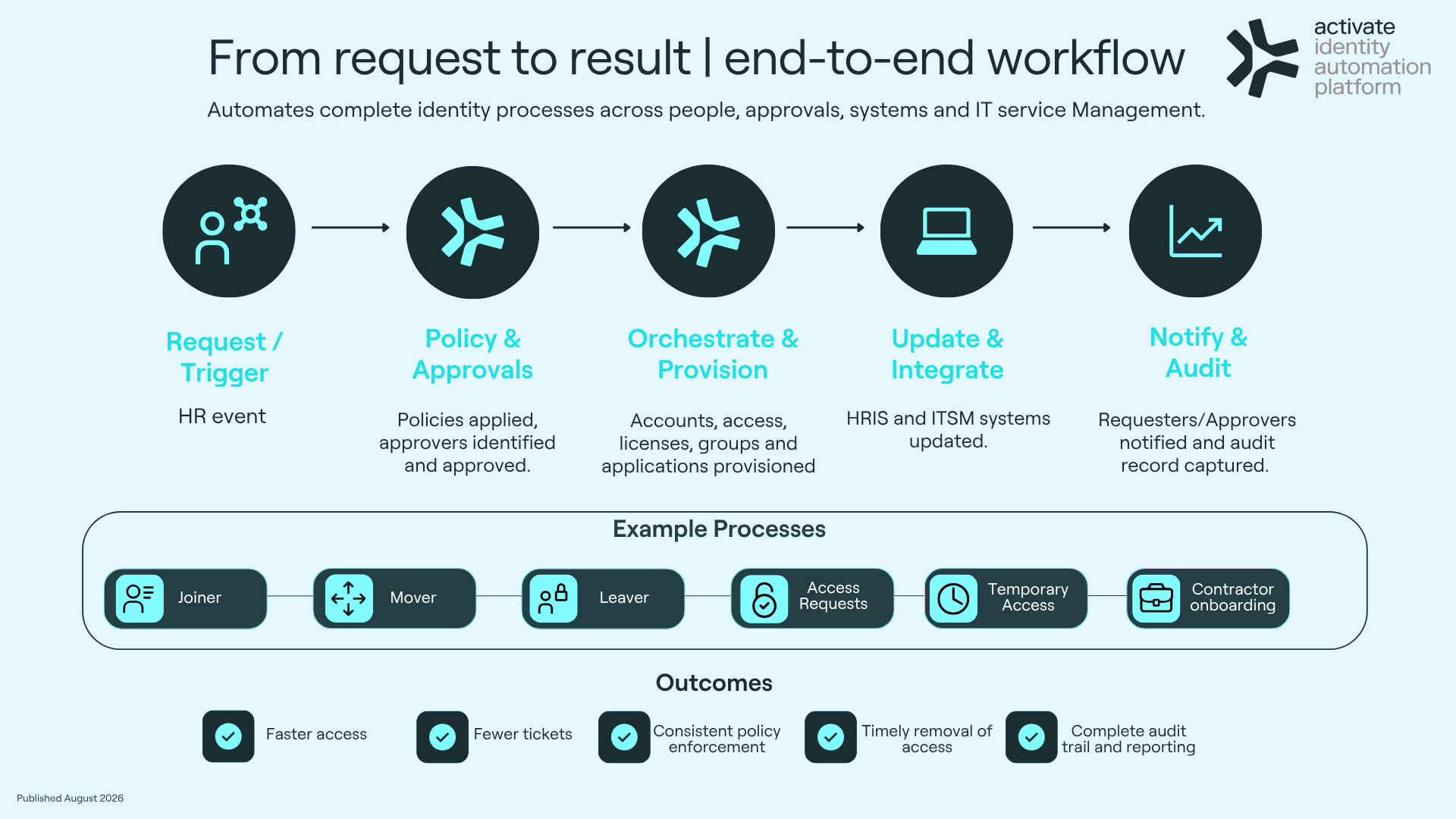
Activate is the identity layer between your systems.
When someone joins, changes role, requests access, or leaves the organisation, multiple systems need to be updated. Without identity automation, these changes become tickets, spreadsheets, emails, scripts, and manual tasks.
Activate acts as the automation layer between systems, coordinating identity changes and ensuring they happen consistently. It automatically translates events into the actions required across your environment.
The result is less manual effort, faster fulfilment, and a clearer model for identity. Activate doesn't replace your existing investments. It makes them work together.
Start with your biggest identity challenge, and expand from there.

Coordinate identity operations across your environment.
Automate workflows across identities, access, assets and services, without replacing your existing systems. Governance, policy and automation working together.

Automate joiners, movers and leavers.
When someone joins or changes role, Activate updates identity and access across your systems.
Faster onboarding. Cleaner access. Better control.

Give people governed access without sending every request through the service desk.
Activate manages self-service requests, approvals, provisioning, time-bound access and audit records.
Built for real-world environments
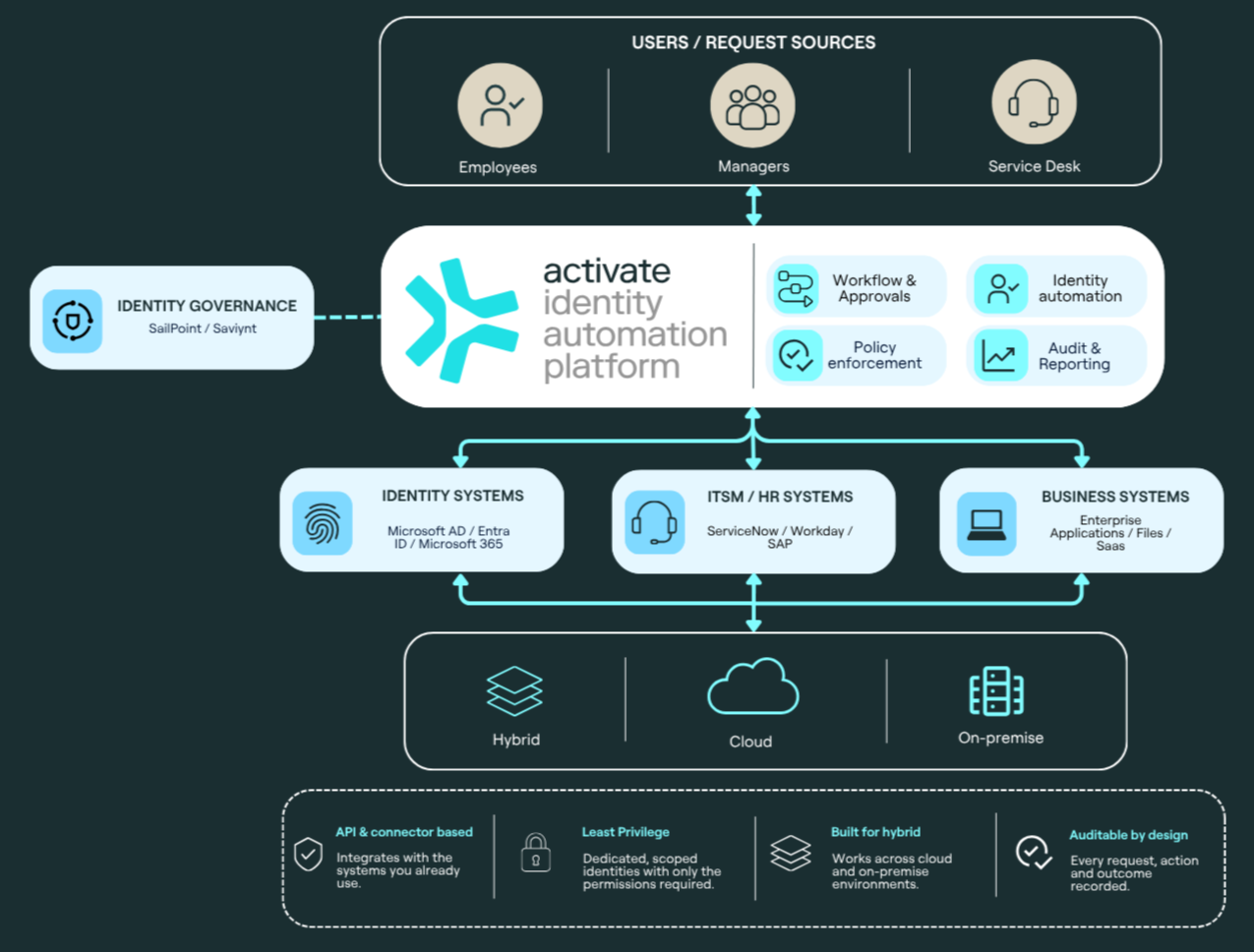
Most organisations aren't cloud-only, and their identity environment extends well beyond the employee directory. Activate works across
Active Directory
HR systems
ServiceNow and ITSM
Microsoft Entra ID, Microsoft 365 and collaboration services
Business applications
File and resource access
Service and privileged accounts
Application, integration and non-human identities
Cloud and hybrid-on premise environments
Identity operations increasingly include non-human identities
Not every enterprise identity belongs to an employee.
Service accounts, privileged secondary accounts, connector identities and application identities all need clear ownership, appropriate access and an audit trail. Yet long-lived environments often accumulate broadly privileged shared accounts used across multiple systems and integrations.
Activate can apply the same operational controls used for workforce identities to non-human identities where supported by the connected environment. This includes named ownership, scoped permissions, approval workflows, time-bound access and auditable execution.
This reduces reliance on broad shared credentials and makes it easier to understand which identity is performing which function, with what access, and why.
AI agents add another identity type to consider. As organisations introduce agents that can request or perform work, the same principles become important: distinct identities, least privilege, clear approval boundaries, traceable actions and the ability to revoke access.
Building these controls into identity operations now creates a cleaner foundation for managing both today's non-human identities and tomorrow's AI agents.
Trusted by customers with complex identity environments.
1 million
Hours saved annually*
31%
Reduction in operational cost*
5 million
Identity tasks automated annually*
20
Years experience in identity automation*
*Across all Activate customers