ServiceNow Identity Automation: What Architects Should Plan Before Go-Live

ServiceNow sits at the centre of many digital workplace projects.
It’s the go-to for many enterprise teams. Employees use it to request access, managers use it to approve work, and IT uses it to manage services, tasks and support. Identity work often runs across a much wider environment.
A single request may need to update Microsoft Entra ID, Active Directory, Microsoft 365, HR systems, business applications and on-premises infrastructure.
That means architects need to decide how identity operations will work across all of those systems before the project goes live. The key questions are practical
Who owns the workflow?
Which systems will be updated?
Which steps will be automated?
How will exceptions be handled?
Who maintains the process once the project team has moved on?
A clear answer early can save the service desk a great deal of manual work later.
In Brief
ServiceNow can support identity automation, including requests, approvals, lifecycle workflows and fulfilment. Some organisations manage these processes within ServiceNow, whereas others connect their ServiceNow with a specialist identity automation platform. The decision is less about product capability, and more about operating model.
Can ServiceNow automate identity processes?
ServiceNow provides workflow, lifecycle and integration capabilities that support identity-related processes, including access requests, approvals, provisioning and lifecycle events.
Many organisations successfully use it as part of their identity automation strategy, although how those capabilities are implemented varies from one organisation to another depending on architecture, operating model and existing technology investments.
Where should identity operations be managed?
Every organisation needs to decide where identity operations will be managed. Some choose ServiceNow as the primary platform for identity workflows. Others use it for requests, approvals and service management while deploying a specialist identity automation platform like Activate to manage their identity operations across directories, HR systems and business applications.
The decision is less about product capability and more about operating model. It shapes where workflow logic lives, who owns it, how changes are made and how identity processes evolve over time. Before making that decision, architects should understand what happens after an identity request is approved.
What happens after an identity request is approved?
Approval is only one step in the process. The work that follows often spans several systems and several teams.A typical request might include:
Checking the request against identity policies
Creating or updating a user account
Updating Microsoft Entra ID or Active Directory
Assigning security groups, roles and licences
Provisioning business applications
Updating Microsoft 365 services
Recording the outcome in ServiceNow
Retaining evidence for audit
Managing exceptions or failed tasks
The important question isn't whether these activities can be automated, it's whether they're designed as one coordinated process or managed separately across different teams and systems.
That design decision has a direct impact on operational effort, user experience and long-term support.
Questions to answer before go-live
Every ServiceNow implementation is different, but the architectural questions are remarkably consistent. Before finalising the solution, ask:
Which identity processes are included in scope?
Which steps will remain manual?
Where will identity workflow logic live?
Which systems need to be updated?
Who owns failed or incomplete transactions?
How will new applications be connected?
Who maintains identity workflows after go-live?
How will operational teams monitor workflow status?
What evidence will be retained for audit?
How will the design adapt as the organisation grows?
These questions help define the operating model before it becomes an operational problem.
ServiceNow or a specialist identity automation platform?
ServiceNow can remain the place employees request and track work, while Activate completes identity processes across Microsoft Entra ID, Active Directory, HR systems and business applications.
It’s not just a product decision, it's an architecture decision.
Some organisations choose ServiceNow as the primary platform for identity automation. Others use it as the employee-facing service platform, while a specialist identity automation platform coordinates identity operations across Microsoft Entra ID, Active Directory, HR systems and business applications. Both approaches are valid.
The right choice depends on factors such as:
Existing technology investments
Internal skills and ownership
Long-term support model
Identity processes already in place
Future application growth
Governance and compliance requirements
The objective is the same in either case: a clear operating model that people can understand, support and evolve over time.
How Activate works with ServiceNow
Activate is designed to work alongside ServiceNow, not replace it. ServiceNow continues to manage requests, approvals and service records. Activate coordinates identity operations across the wider technology environment, including:
Microsoft Entra ID
Active Directory
Microsoft 365
HR systems
Business applications
Hybrid and on-premises infrastructure
Typical identity operations include:
Joiner, Mover and Leaver processes
Access requests
Account provisioning
Group and role management
Licence assignment
Access removal
Policy enforcement
Audit reporting
The result is a connected identity process that can span multiple systems while keeping the employee and service experience within ServiceNow.
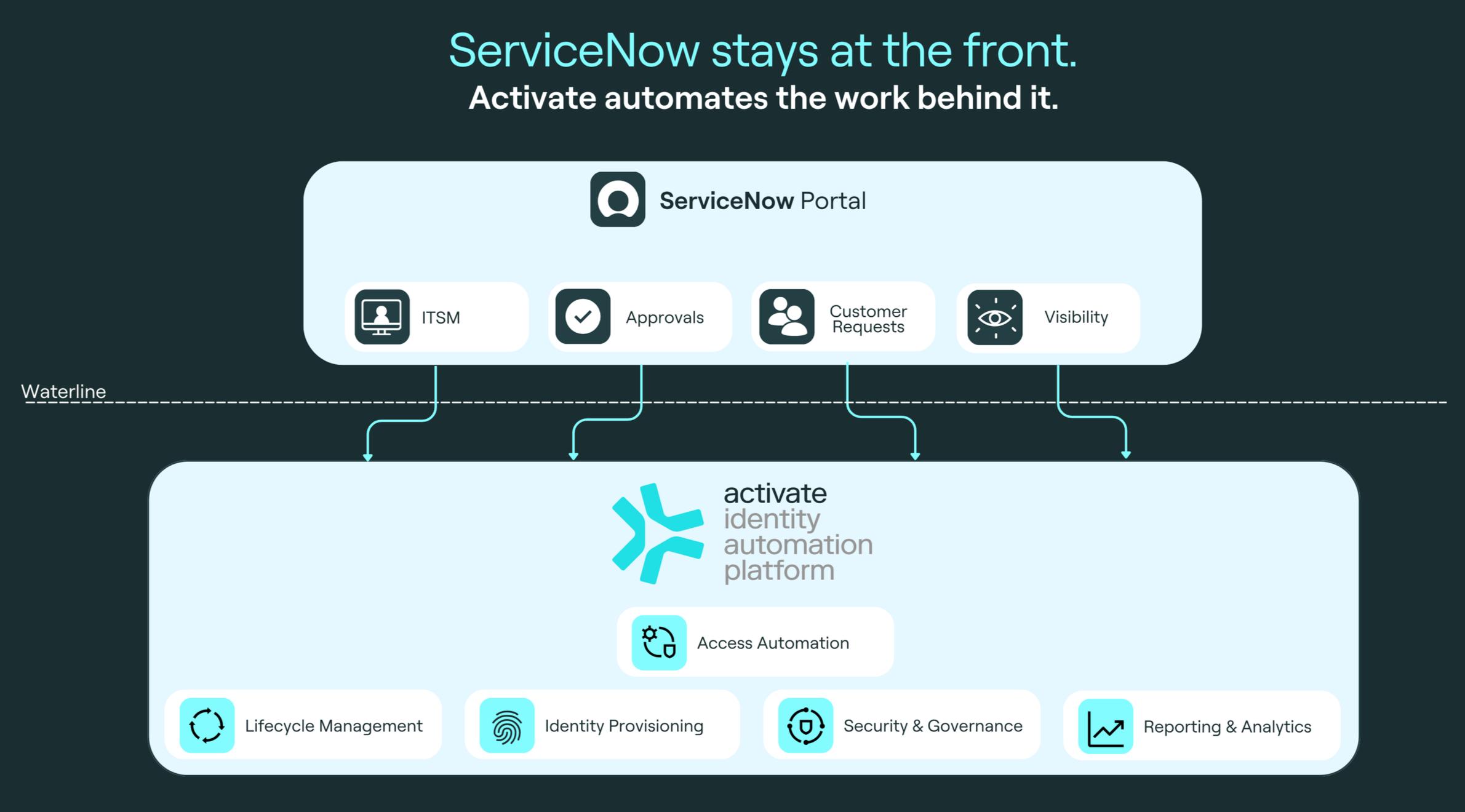
Activate and ServiceNow coexistence model.
What to remember.
Every organisation needs identity automation. The design question is where those identity operations should live and how they will be managed over time.
Answering that question early gives project teams, operational teams and service desks a shared understanding of how identity work will be delivered after go-live. That's often the difference between a successful implementation and a sustainable operating model.
Planning identity automation around ServiceNow?
Explore how Activate can work alongside your existing ServiceNow environment.

Explore related resources
Discover how Activate helped customers automated identity and access operations.
AI Identity Architecture Webinar
Robbie and Roy Robinson, our Lead Enterprise Automation Architect discuss how identity models are evolving to support AI-driven environments.
Robbie and Roy Robinson, our Lead Enterprise Automation Architect explore the governance, security and operational challenges created by AI agents and machine identities.
Follow me Robert Burke and Activate on LinkedIn for more practical insights on governed automation, enterprise AI and identity-driven workflows.