
Identity Orchestration Explained
The hidden cost isn’t your IAM platform. It’s the work around it.

Manual effort, delays, risk and complexity can quietly add up as your environment grows.
Most organisations can keep identity moving through a mix of platforms, tickets, scripts, approvals and manual work.
The problem is that “working” doesn’t always mean efficient, scalable or low-risk.
As your organisation grows, adds applications and manages more identities, the effort required to keep everything running can quietly increase.
Five signs that “good enough” may be becoming expensive.
1
Too much skilled time is spent on manual identity work.
How much time does your IAM, IT or Service Desk team spend on:
access requests
joiners, movers and leavers
chasing approvals
updating groups and applications
handling exceptions
maintaining scripts
gathering audit evidence?
The real cost isn’t just the time spent doing the work, it’s what your team could be doing instead.
Ask yourself:
How much of this work really needs a person involved?
2
Identity decisions don’t always become outcomes automatically
Your governance platform may decide who should have access, but that decision still has to be carried out across:
HR systems
Entra or Active Directory
ServiceNow
Applications
Groups
Licences
Shared resources
That creates an identity execution gap between what should happen and what actually happens.
Ask yourself:
When access changes, how confident are you that it happens consistently, everywhere it needs to?
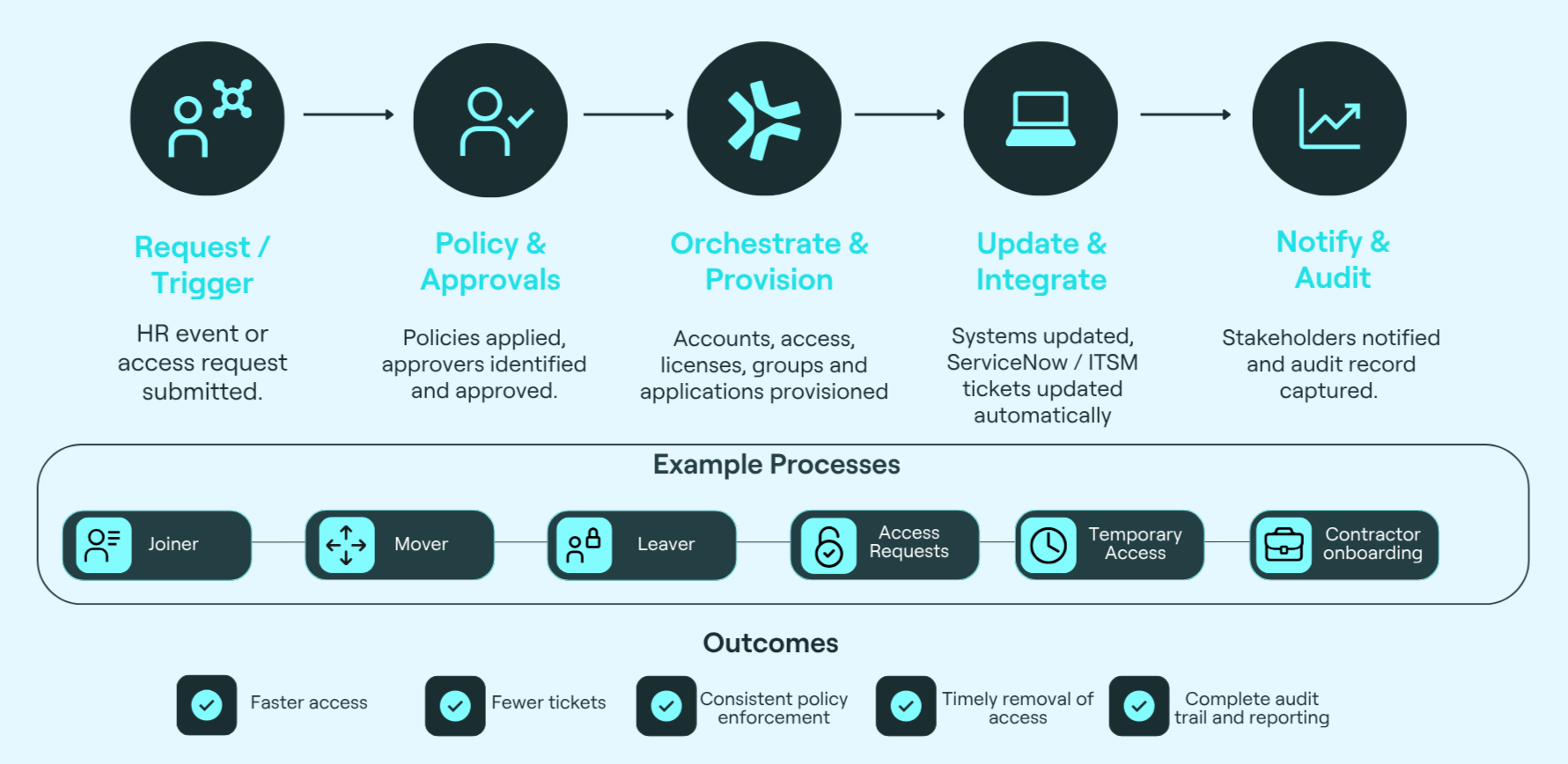
From request to result | end to end workflow
What actually happens behind an identity request
3
Manual processes create delays
Identity work often involves waiting.
Employees wait for access.
Managers wait for requests to be fulfilled.
Service desks wait for approvals.
Teams wait for someone to complete the next step.
One government organisation using Activate reduced new-user provisioning from five days to under five minutes and saved more than 10,000 support hours annually.
Ask yourself:
How much productive time is lost while people wait for identity work to happen?
4
Complexity keeps growing.
Manual processes rarely break overnight, they simply become harder to manage as you add:
more applications
more business units
acquisitions
more compliance requirements
more exceptions
machine identities
AI agents
What works today may not work as identity environments grow increasingly complex.
Ask yourself:
Would your current Identity Operations model still work if the environment doubled in complexity?
5
Your processes depend on people, scripts & workarounds
Many identity environments work because experienced people know how to keep them working.
They know which script to run.
Which exception applies.
Who needs to approve something.
What to do when a workflow fails.
That knowledge is valuable, but it can also become a dependency.
Ask yourself:
What becomes difficult if the person who understands the process isn’t available?
Sound familiar?
You may have an Identity Operations opportunity if:
Routine identity changes still generate Service Desk work
Joiner, Mover and Leaver processes contain manual steps
Exceptions regularly require human intervention
Important processes rely on scripts or individual knowledge
Employees sometimes wait for access after approval
Audit evidence is gathered manually
Adding applications creates more identity administration
AI and non-human identities are increasing complexity
Retail Identity Automation.
See how a national retailer uses Activate to handle over 107,000 automated provisioning requests annually.
Read the case study here.
Global Enterprise Access Automation.
See how a global dairy enterprise seamlessly handles 300,000+ automated requests natively through their existing ITSM portal.
Read the case study here.
Looking to understand how Activate’s pricing works?
If these sound familiar, the issue may not be your IAM platform.
It may be the operational work happening around it.
You may not need another IAM platform
Most enterprises already have strong identity technology. Stacks like;
Microsoft Entra.
SailPoint or Saviynt.
ServiceNow.
HR systems.
Business applications.
The challenge is making them work together. That’s where Identity Operations comes in.
Identity Operations is the work required to turn identity decisions into completed outcomes across all the systems involved.
Activate automates and orchestrates that operational layer by helping reduce tickets, manual hand-offs and repetitive administration without replacing the platforms you already use.
What does identity operations look like in practice?
40 hours saved per week.
A national media organisation reported saving approximately 40 hours every week in manual system administration after automating user provisioning and identity lifecycle management.
Read the case study
10,000 support hours reduced annually.
A New Zealand government organisation reported more than 10,000 support hours saved annually and reduced new-user provisioning from five days to under five minutes.
Read the case study
The point isn’t simply automation.
It’s reducing how much effort it takes to keep identity operations running.

What could you stop doing manually?
You don’t need to begin with a major transformation programme - start with a single process.
A Joiner, Mover or Leaver workflow.
An access request.
A recurring Service Desk task.
A provisioning process.
An exception your team handles repeatedly.
Bring us one workflow, and we’ll help you identify where the manual effort sits and whether it’s a good candidate for automation.