
Activate Customer Reduced New-User Provisioning From 3-5 Days to Under 10 Minutes

Customer Snapshot
Organisation: Leading Australasian bank
Industry: Financial services
Workforce: More than 7,500 employees
Environment: Active Directory, enterprise banking applications and internal services
Jobs to be done: Automate workforce and privileged-account lifecycles, govern access and manage privileged accounts more consistently
Accounts managed: Employee, contractor, service, administrator and vendor accounts
Solution: Activate Identity Operations
The Challenge
All account and access changes for the bank’s 7,500+ employees were managed manually by a central request team. Requests often took several days to complete and inconsistent processing created avoidable errors and additional service-desk work.
Active Directory supported authentication and access across applications, software, secure folders and distribution lists. Over time, it had become increasingly difficult to manage. Duplicate groups, unclear ownership and limited visibility made it harder to understand who had access and why.
User accounts were also created, changed and removed without a clear connection to individual employees. Legacy accounts accumulated, leaving the bank unable to easily confirm whether they were still required.
Privileged accounts added another layer of risk. Service, administrator and vendor accounts needed stronger ownership and lifecycle controls because they did not always follow the same processes as employee identities.
The Jobs the Bank Needed to Get Done
The bank needed a more reliable way to:
Provision, update and remove employee accounts
Link user accounts to the people responsible for them
Give employees appropriate access based on their department and location
Reduce duplicate Active Directory groups
Establish clear ownership for services and access
Manage service, administrator and vendor accounts
Review access regularly
Reduce unmanaged and orphaned accounts
Make identity changes visible and auditable
The goal was not simply to process requests faster. The bank needed a consistent operating model for managing workforce and privileged identities throughout their lifecycle.
Where the Hidden Costs Were Building
The cost of manual identity operations was spread across thousands of individual requests. Every account creation, access change, group update and offboarding action consumed time from the central request team.
Errors created more work. Incomplete information, inconsistent decisions and manual hand-offs led to service-desk tickets that could have been avoided.
Legacy and privileged accounts created less visible costs. When an account lacked a clear owner or lifecycle connection, teams had to investigate whether it was still needed. Accounts that remained active for too long also increased security, compliance and audit exposure.
As request volumes grew, the bank faced a choice: add more manual capacity or automate the work behind each identity change.

The Solution: Automate Identity Operations Across the Bank
The bank selected Activate Identity Operations to automate its internal identity management and IT processes. The first phase focused on high-value processes where automation could quickly reduce delays and improve control. Activate introduced:
Automated employee onboarding and offboarding
Account creation, updates, moves and deprovisioning
Department and location-based role management
Role-based access derived from HR information
Self-service access requests
Service ownership and approval workflows
Access and application reviews
Audit records for identity and access changes
The bank’s existing Active Directory groups and applications were mapped to Activate Services. Approximately 1,500 services were identified and created from the first day through group discovery.
Activate then used role discovery to identify common entitlements. Where most people in a role shared the same access, that access could be assigned automatically as a default entitlement.
Bringing High-Value Systems Under Automated Control
The bank progressively extended automation to important applications and services, including:
Retail banking teller systems
Customer relationship management
Contractor, vendor and non-employee accounts
Distribution lists
Secure folders and file data
Shared mailboxes
Password resets
Mobile phones and extensions
Induction and pre-termination processes
Out-of-office messages based on HR leave records
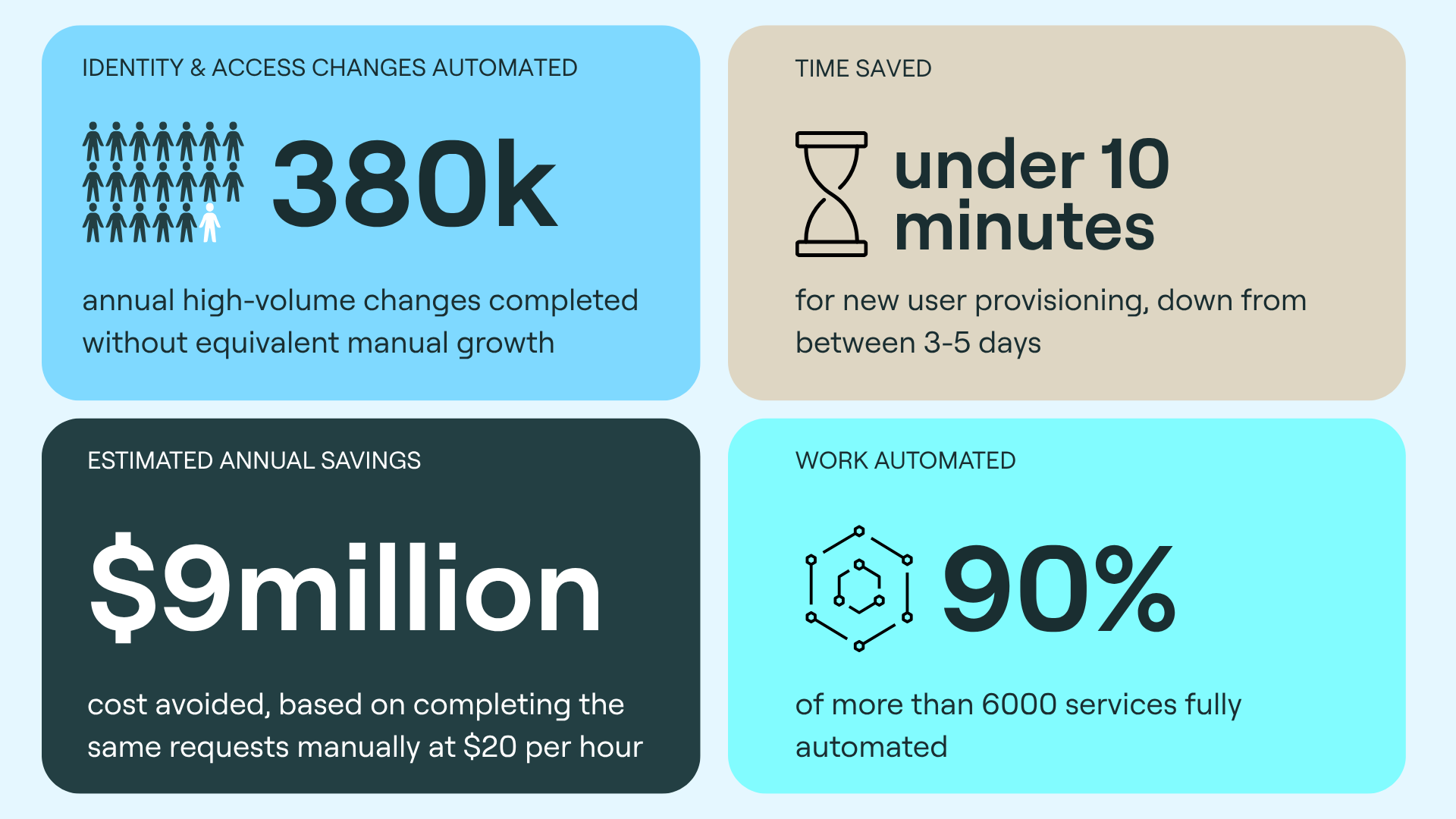
Over time, the service catalogue grew from approximately 1,500 services to more than 6,000, with over 90% now fully automated.
Automating Privileged Account Lifecycles
The bank also brought service, administrator and vendor accounts into its identity operating model.
Activate automated lifecycle controls around these privileged accounts, helping the bank manage their creation, ownership, ongoing access and removal more consistently.
This made it easier to:
Apply repeatable processes to privileged accounts
Identify the people responsible for service and administrator access
Manage vendor access as requirements changed
Include privileged accounts in reviews and governance processes
Remove access when it was no longer required
This automation complemented the bank’s wider privileged-access security controls. Activate managed the identity operations around privileged accounts rather than replacing specialist functions such as password vaulting or session monitoring.
Strengthening Governance Beyond Onboarding and Offboarding
The bank continued to expand its automation and governance controls after the initial implementation. Scheduled reviews allowed business and service owners to review roles, users and application access. Governance workflows could also enable or suspend accounts based on mandatory-leave requirements.
Pre-termination processes supported risk assessments before people left, while automated offboarding helped ensure employee, contractor and vendor access was removed consistently.
The Outcome: Identity Automation at Enterprise Scale
Activate now automates more than 380,000 changes annually for the bank, with over 900,000 user-service relationships under management.
New-user provisioning has fallen from three to five days to under ten minutes. More than 80% of requests were fully automated from the first day; that figure has since increased to over 90%.
Monthly request volumes grew from approximately 5,000 to more than 32,000 without a corresponding increase in manual overhead. At an estimated manual cost of $20 per request, the bank calculates that automation avoids more than NZ$9 million in annual costs.
The bank has also gained stronger control over employee, contractor and privileged-account lifecycles. Clearer ownership, regular access reviews and automated deprovisioning make it easier to identify access that is no longer appropriate.
The bank has remained an Activate customer since 2007, continuing to extend the platform as its operational, security and governance requirements have evolved.
The Bottom Line
The hidden cost of identity management was not limited to slow onboarding. It was spread across every account creation, access change, group update, review and offboarding task completed manually.
Privileged accounts increased that cost and risk. Service, administrator and vendor access needed the same clear ownership and lifecycle discipline as employee identities.
By automating workforce and privileged-account operations, the bank created a more consistent way to manage identity changes across its complex environment.
The result was faster access, less manual work and stronger governance at a scale that would otherwise have required significant additional operational capacity.
How Much Manual Work Is Hidden Across Your Identity Environment?
Activate can help automate workforce and privileged-account lifecycles while improving ownership, governance and auditability across your connected systems.