
The New Zealand Herald (27 April, 2026) just reported that automation engineers are the fastest growing role in New Zealand, with job demand up nearly 185% over a six month period. It’s an interesting signal, but I don’t think the number itself is the most important part.
What matters more is what sits underneath it. From where I sit, this isn’t really a story about automation suddenly becoming important. It’s about AI forcing organisations to confront execution properly for the first time in a while.
AI can generate, but enterprises still need certainty.
The industry has broadly settled on calling a wide range of things “AI”, but in practice most of what people are interacting with today are large language models. They are very good at generating content, whether that’s code, documentation, ideas, or structured outputs. In some ways, they’re the closest thing we have to digital imagination. They can take a vague prompt and produce something surprisingly coherent. That fuzziness is the feature. It’s also the problem.
LLMs are probabilistic by design. You don’t get the same answer every time, and even when you do, you can’t rely on it in the way you would a deterministic system. That makes them incredibly useful for drafting and exploration, but much harder to trust when the outcome needs to be consistent, repeatable, and auditable.
Enterprise systems tend to care about those properties more than anything else. This is where I think the rise in automation engineering starts to make more sense. Not as a counterpoint to AI, but as a necessary complement to it.
The real challenge is operationalising AI.
If you look at how organisations are actually adopting AI, the gap isn’t in access to models. Most companies can call an API. Many are already experimenting, and some are doing so quite extensively. McKinsey, for example, reports that around 78% of organisations are using AI in at least one function, yet only about 21% have meaningfully redesigned workflows to take advantage of it .
That gap is doing a lot of work. It suggests that the bottleneck has shifted away from capability and into integration. Not “can we generate something with AI?”, but “how does that output actually move through a system, trigger decisions, interact with controls, and produce a reliable outcome?”
Automation engineering is becoming the bridge between AI and execution.
Those are not model problems. They are workflow problems. Automation engineers sit directly in that space. They are the people who take something that could be done and turn it into something that reliably happens.
There’s also a subtle shift happening in how software gets created. Tools like Copilot and similar have changed the cost profile of writing code. GitHub’s own research suggests developers can complete certain tasks around 55% faster with AI assistance , and broader surveys show that a large majority of developers are now using or planning to use AI tools in their workflow.
AI is increasing the volume of automation.
That has an interesting side effect. It doesn’t just make developers faster. It increases the volume of potential automation. Things that previously weren’t worth scripting now are. Internal processes, small integrations, one-off data flows, operational glue code. AI turns all of these into “we could probably automate that in an afternoon” rather than “that’s a backlog item we’ll never get to”.
So you end up with a surge in draft automation. But drafts don’t run enterprises. To get from a generated script to something that sits inside a production environment, you still need identity, permissions, logging, monitoring, versioning, rollback, and some notion of ownership. You need to know what happens when it fails, who gets notified, and how it interacts with everything else.
Why fully autonomous agents create new operational risks.
In other words, you need engineering discipline. This is where I think some of the conversation around agents becomes a bit muddled. There’s a tendency to assume that because an agent can perform a task, it should be allowed to perform that task end to end. Sometimes that’s fine. A bounded, low-risk task where variability is acceptable can be a good fit for an agent. But a lot of enterprise work doesn’t look like that.
If the task is to move files between systems, reconcile records, trigger downstream processes, or update critical data, then handing that entirely to an autonomous agent introduces a different class of problem. Not just correctness, but cost, observability, and control. Each step the agent takes consumes resources, and the path it takes may not be consistent.
You can do it that way. Or you can ask the model to generate a script once, review it, version it, and run it deterministically as many times as you need.
The emerging model: AI-assisted automation.
The second option looks a lot more like how enterprises have always operated, and it’s also significantly easier to govern. Most of the guidance coming from model providers themselves points in this direction. Use models where you need reasoning or flexibility, but wrap execution in deterministic workflows, with guardrails and human checkpoints where appropriate .
That hybrid approach feels less like a compromise and more like a natural architecture. AI becomes the layer that helps you design and accelerate. Automation becomes the layer that ensures things actually happen the same way twice.
Why automation engineers are becoming more valuable
When you look back at that 184% growth figure for automation engineers, it starts to look less like a spike and more like a lagging indicator. Organisations are realising that having access to AI is not the same as being able to operationalise it.
New Zealand is an interesting case because the broader policy direction is explicitly focused on practical adoption rather than frontier research. There’s also a clear skills gap, with a significant portion of businesses citing lack of expertise as a barrier to using AI. In that kind of environment, the people who can bridge intent and execution become disproportionately valuable. Not because automation is new, but because the volume of things worth automating has increased.
AI has an operational cost model too.
I also think there’s a financial lens to this that doesn’t get discussed enough. Running AI interactions at scale has a cost, whether that’s API usage or internal compute. If you rely on agents to repeatedly perform tasks that could be codified once, you’re effectively turning something that could be capitalised into something that sits in your operational spend.
A script, once written and deployed, behaves more like an asset. It can be versioned, reused, improved, and run at near-zero marginal cost.That distinction matters more as usage scales.
The future is governed automation.
So when we talk about “AI automation”, I’m not convinced the most valuable form is fully autonomous systems making decisions independently. The more durable pattern, at least in enterprise environments, seems to be AI-assisted automation. Humans remain accountable, AI accelerates creation, and deterministic systems handle execution.
Automation engineers sit right in the middle of that. They’re not replacing AI, and AI isn’t replacing them. If anything, each is increasing the value of the other.
When it comes to AI gover
nance we’re still early, and structure is catching up.
The part I’m still working through is how standardised this becomes. Right now, a lot of this knowledge sits with fairly technical teams who are figuring it out through implementation rather than doctrine. Over time, I suspect we’ll see more defined patterns emerge around how agents, workflows, and governance fit together.
But in the meantime, we’re in a slightly awkward phase. There’s a lot of capability, a lot of experimentation, and not quite enough structure, which is usually when engineering roles that bring structure tend to become important.
- Robbie
Explore related resources
AI Identity Architecture Webinar
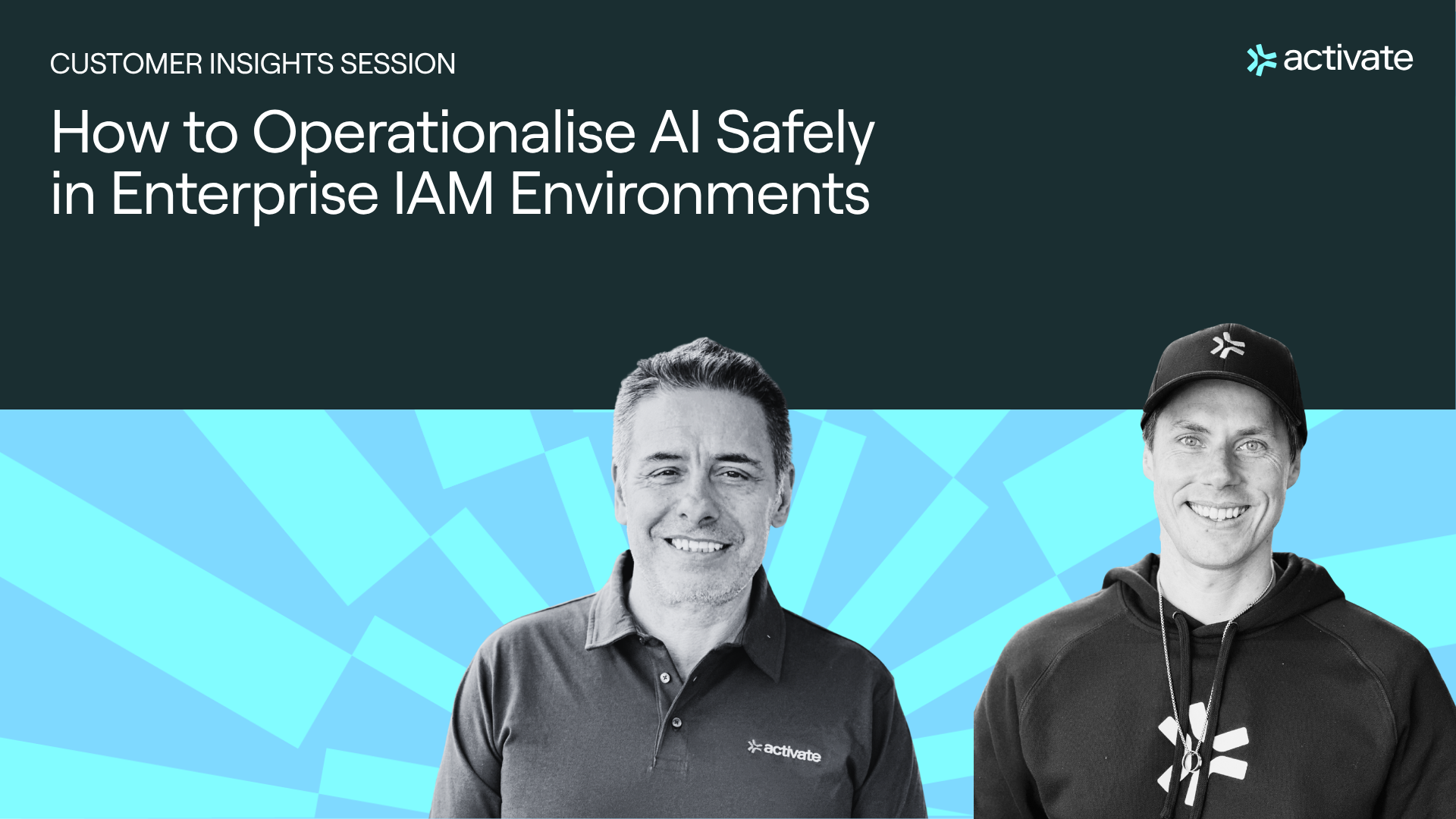
Robbie and Roy Robinson, our Lead Enterprise Automation Architect discuss how identity models are evolving to support AI-driven environments.
Robbie and Roy Robinson, our Lead Enterprise Automation Architect explore the governance, security and operational challenges created by AI agents and machine identities.
See how Activate automates identity operations across HR, IT and identity systems.
Follow me Robert Burke and Activate on LinkedIn for more practical insights on governed automation, enterprise AI and identity-driven workflows.